Skip to content

Seattle, WA

206-590-1556

www.PurpleAcu.com

Seattle Community Acupuncture: Happy Effects of Acupuncture

A colleague in Portland, Oregon shares the “built-in” positive effects of getting poked! Her article appeared in AcuTakeHealth.com on Aug 15, 2012:

5 Most Common Side Effects of Acupuncture

Article and photo by Sara Calabro

Forget what you’ve been told. Acupuncture does have side effects. The unintended consequences of acupuncture, while not life-threatening, should not be overlooked. The side effects of acupuncture occur frequently and can seriously impact on your quality of life.

Here are the five most common side effects of acupuncture. Consider yourself warned.

Better sleep

Insomnia is one of the most common complaints seen by acupuncturists, and acupuncture can be highly effective at resolving it. But even in people who do not recognize or mention sleep as a problem, acupuncture has a tendency to produce more restful nights. This often goes unnoticed until asked about on a follow-up visit. Many acupuncturists hear this refrain multiple times a day: “You know, now that you mention it, I have been sleeping a lot better since I started coming for acupuncture.”

More energy

Although it’s common to find yourself in “acu land”—a somewhat dazed, blissfully relaxed state—immediately following acupuncture treatment, the after effect is usually increased energy. Many people report having more energy in the hours, days and even weeks after acupuncture treatment. You may notice that you’re avoiding that post-lunch coma, feeling more motivated to hit the gym, or just sensing a little extra spring in your step.

Mental clarity

Acupuncture resolves the stagnation that causes many of us to feel physically and mentally lethargic. In addition to the surge of physical energy that follows emerging from acu land, many people notice improved mental clarity. They’re able to make decisions faster, with greater confidence. They feel more motivated and resolute about tackling items that have been lingering for months on their to-do lists. It’s as if the mental cobwebs have been cleared out. Suddenly, you’re able to get out of your own way.

Better digestion

Digestion is big in acupuncture. The organ systems and meridians that regulate digestion are intimately connected to all other structures and functions throughout the body, so a person’s digestive health says a lot about his or her overall state of health. This is why acupuncturists ask such detailed questions about eating habits and bowel movements. It’s also why getting acupuncture for shoulder pain, for example, might cause you to use the bathroom more regularly, feel less bloated after meals, and experience fewer food cravings.

Less stress

Stress reduction is a common reason for seeking acupuncture. However, not everyone admits or even feels that they have stress in their life. They’ve gotten so used to living with a certain level of stress that it has become their “normal.” It’s only in the absence of stress that they notice how stressed out they were to begin with. Acupuncture heightens our awareness such that stressful events, initially, can actually be felt more acutely. But overtime, by evening out our moods, acupuncture allows us to feel less affected by and better equipped to manage the stressful aspects of our lives.

So there you have it. The truth, once and for all: Acupuncture has side effects that can significantly influence your quality of life.

Posted in Uncategorized | Comments Off on Seattle Community Acupuncture: Happy Effects of Acupuncture

Seattle Community Acupuncture: Olympic Athletes Get Acupuncture

Acupuncture is great for sports injuries of all kinds, whether you’re someone who works out at a gym or a serious competitor, such as these Olympic greats:

6 Olympians Who Ache For Acupuncture

from The Daily Zeel: Healthy Living via Yahoo Shine continue reading »

Posted in Uncategorized | Tagged , , , , , , , | Comments Off on Seattle Community Acupuncture: Olympic Athletes Get Acupuncture

Seattle Community Acupuncture: Inflammation Reduction with Acupuncture

Acupuncture relieves pain and inflammation in the body. The thermographic image above shows inflammation reduction in the knee as acupuncture relieves knee pain.

Inflammation is the body’s common response to injury, irritants, toxins, allergic substances, and pathogens.  It is present in most medical conditions and is often the cause of pain. Some of the many conditions that involve inflammation are arthritis, diabetes, cardiovascular disorders, asthma, cancer, sprains, strains, bruises, carpal tunnel syndrome, allergic reactions to any substance, skin conditions, PMS, irritable bowel syndrome, Crohn’s disease, any digestive disorder, and many kinds of pain.

When the body first detects something is wrong somewhere, whether it is an injury, virus, allergic reaction, or internal disease, it sends extra blood rushing to the affected area with disease- and injury-fighting blood components such as white blood cells (leukocytes) to repair the damage. The warmth, swelling, and/or red skin you might notice are due to the extra blood in the affected area. It is possible – and quite common – to have such inflammation in your body and be unaware of it, such as in early stages of disease and in chronic internal conditions. Inflammation is often the root of pain and other “dis-ease” in the body.  Community acupuncture is a great way to relieve inflammation in your body.

Posted in Uncategorized | Tagged , , , , , , , , , | Comments Off on Seattle Community Acupuncture: Inflammation Reduction with Acupuncture

Seattle Community Acupuncture: 5 Acupuncture Myths Debunked


Here is an informative article from AcuTakeHealth.com. It answers questions a lot of people have about acupuncture.

Have You Heard These Acupuncture Myths?

By Ka Hang Leoungk

As an acupuncturist, I do a lot of myth debunking. It’s understandable. After all, acupuncture speaks an entirely different language from the one through which most Westerners learned to see the world. However, with acupuncture continuing to grow in popularity and gain acceptance by mainstream medicine, it’s important to clarify a few myths and misconceptions that have a strong hold on our collective psyche.

Here are the five most common myths and misconceptions I hear about acupuncture.

“Acupuncture is only for pain.”

Ask most people what acupuncture helps with and the overwhelming majority will say pain. It is true that acupuncture can work wonders for back pain, headaches, neck pain, shoulder pain, leg pain, postoperative pain, and pretty much any other kind of pain you can think of. However, pain is just one of many ailments for which acupuncture can provide relief.

Acupuncture alleviates digestive problems, menstrual irregularities, allergies, insomnia, stress and anxiety, asthma, and several other conditions. While many acupuncturists are generalists who treat a wide range of ailments, some specialize. So do a little homework before booking an appointment to find out whether an acupuncturist has experience treating whatever you need help with. The AcuTake Acupuncturist Directory, searchable by condition, is a great place to start.

“Acupuncture doesn’t work because I’ve had it once and nothing changed.”

I hear this one a lot. It’s a myth that is easily debunked by thinking about your car. If you go for years without getting your car checked, when you take it to the mechanic it’s going to require more work than if you had come in for regular tune-ups. Similarly, if you’ve been experiencing back pain for six months, it will probably take more than one acupuncture treatment before you notice results.

After your first treatment, an acupuncturist usually will provide an estimate for how many treatments you’re likely to need. This is always an estimate because response times to acupuncture can vary widely, but it’s a good guideline.

Acupuncture is a cumulative process, much like going to the gym: You don’t start running faster or lifting heavier weights after just one trip. That said, most people notice at least some changes after 10 acupuncture treatments. If you haven’t seen any improvement after giving it 10 appointments, I suggest trying another acupuncturist.

“Acupuncture doesn’t work because we don’t know how it works.”

This is an understandable misconception. When it comes to concepts with which we are unfamiliar, it’s comforting to have solid proof. Although there is tentative evidence of acupuncture’s efficacy, definitive, Western-friendly proof of how acupuncture works is unavailable.

There is good reason for this. Controlled, double-blind trials are inappropriate for studying acupuncture. Most acupuncture research models look at a standard selection of acupuncture points to determine if they are effective for a certain condition. But from an acupuncture perspective, one condition can have several different causes—and therefore would require completely different acupuncture points.

Researchers are beginning to look at acupuncture using MRI. I believe this method of studying acupuncture is the most promising yet. Rather than concentrating on people’s perceptions, which can be misled by placebos or prejudices, the MRI studies look directly at how acupuncture changes brain activity. These MRI studies also address findings from previous research that show effects from fake or “sham” acupuncture. Through MRI, we know that both real and sham acupuncture relieve pain but that the effects on the brain are considerably different.

We may not know yet exactly how acupuncture works, but we are gaining a better understanding of the therapeutic effect that acupuncture causes.

“Acupuncture hurts.”

I disagree with acupuncturists who say that acupuncture needles are so thin you can’t even feel them. In my experience, most people feel acupuncture.

When needles are inserted in the right places, they often produce a feeling of heaviness, like a dull ache. Since this sensation is unfamiliar for most people who have never had acupuncture before, it’s commonly interpreted as pain.

If I describe this dull-achy feeling to people before beginning a treatment, they are less likely to experience the sensation as pain. They are prepared, which means their bodies are less tense. Often the “hurt” associated with acupuncture can be attributed to anxiety about the unknown.

I also make a point of telling my patients that acupuncture—rarely, but on occasion—can cause pain after a treatment. Sometimes needles in certain acupuncture points, after they’re removed, can cause a residual feeling of ache, almost like a bruise. When people understand ahead of time that this is a completely normal outcome, their perception of acupuncture as something that hurts seems to shift.

“Acupuncture is religious.” (Also known as “Acupuncture is voodoo.”)

I have been told, “I don’t believe in acupuncture because I’m a Christian.” Although it’s becoming less common as the general public gets more educated about acupuncture, the myth of acupuncture as a religion or supernatural phenomenon remains.

Acupuncture is not religious, nor is it voodoo. There is nothing supernatural or otherworldly happening during an acupuncture treatment. Acupuncture is a healthcare modality designed to help balance your body’s various, interconnected systems.

You don’t need to “believe” in acupuncture in order to experience its benefits because there is nothing to believe in.

I think some of the misinformation surrounding acupuncture’s origins and intentions stems from the word “qi,” which is often described as “vital energy.”

A better interpretation of what ancient Chinese practitioners meant by qi is simply oxygen. They understood that oxygen and nutrients were needed throughout the body in order for it to function properly. They called it qi and Blood, but acupuncture is merely a tool for moving the oxygen and nutrients that our bodies need to thrive.


Posted in Uncategorized | Tagged , , , | Comments Off on Seattle Community Acupuncture: 5 Acupuncture Myths Debunked

Seattle Community Acupuncture: 8 Things to Remember Before an Acupuncture Appointment

There are a few things you can do to make the most of each acupuncture treatment. Whether you are new to acupuncture or have been getting poked for quite some time, you could benefit from the tips in the article below. Think of it as a pre-acupuncture checklist.

8 Things to Remember Before an Acupuncture Appointment

by Sara Calabro, acupuncturist and founding editor of AcuTake online acupuncture journal.

Acupuncture isn’t really into hard-and-fast rules. What works for one person may not necessarily work for another. This is the beauty of acupuncture—it meets us wherever we’re at.

However, there are some general rules of thumb when it comes to preparing for an acupuncture appointment. All are tweakable based on your constitution and preferences, but in my experience, these guidelines tend to improve the treatment experience and outcome for most people.

Are you ready to get the most out of your next acupuncture treatment? Remember these eight things.

Schedule wisely.

Avoid scheduling acupuncture before or after something really strenuous. You don’t need to be sedentary on either side of an appointment, but nor should you be going nuts at the gym or suffering through an extremely stressful meeting. Also avoid sandwiching—squeezing in acupuncture immediately between two other events—as this has a tendency to make you either late for or stressed out during your treatment.

Eat.

This is an important one, and it’s something I get asked about a lot. Everyone metabolizes food at different rates, so adjust as you see fit, but a good guideline is to eat about two hours before an acupuncture appointment. You don’t want to show up really full, or after having eaten something heavy, fried or spicy, but do not go for acupuncture on an empty stomach. It can leave you feeling lightheaded or physically depleted. If you’re debating whether it’s too close to your appointment to eat, eat. Better to be a little full than distracted by hunger during your appointment.

Coffee is not your friend.

That is not to say that coffee is never your friend, but coffee is not your friend immediately before acupuncture. If you have a morning appointment and can’t go without your morning cup, do what you have to do. But if you’re going for acupuncture later in the day, avoid coffee for at least two hours before.

Coffee is a stimulant. It has been shown to release norepinephrine and epinephrine, which kick your body into fight-or-flight mode. Acupuncture works to shift you away from that sympathetic (fight-or-flight) state and toward a parasympathetic (rest-and-digest) one, so coffee inhibits the process. It also makes it difficult for the acupuncturist to get accurate readings on your pulse and tongue, since coffee increases your heart rate and stains your tongue.

Neither is alcohol.

One of acupuncture’s greatest gifts is its ability to help us see more clearly. Not literally, as in improved vision (although it has been known to do that too), but it helps us see situations and our symptoms with more clarity. Alcohol does the opposite. It numbs us, takes the edge off, which during acupuncture is not a good thing. One goal of acupuncture is to bring more awareness to how we feel. Impairing the senses with alcohol is not helpful.

Remember where you’ve been.

Before acupuncture, spend some time thinking about—or even making a list, if that helps—any significant medical events in your life. For example, family disease history, car accidents, broken bones, other serious injuries, long-term illnesses, surgeries, etc. Also make note of any medications you are taking currently as well as any that you took long-term in the past (e.g., birth control pills).

We tend to forget these things, or assume they’re irrelevant, but from an acupuncture perspective they help contribute to your overall picture of health. Your acupuncturist will want to hear about them. When in doubt about whether to include something, it’s always better to mention it.

Wear loose clothing.

This is so the acupuncturist can easily access the places where he or she wants to place needles. It’s especially important if you’re going for a community acupuncture appointment, because treatments are performed in a group setting with clothes on. However, even for private acupuncture appointments, loose clothing usually makes things easier for you and the practitioner.

Don’t rush.

Even when we schedule wisely, there is still a tendency to leave at the last minute for appointments. This makes most appointments more stressful than they need to be, but especially with acupuncture, arriving at your appointment amped-up is counter productive. It’s similar to how coffee works against the process of calming the nervous system. When you rush into an appointment, your pulse is higher than normal, your mind is spinning, and you’re tense with worry about the prospect of being late.

Many of us already deal with these qualities during our regular stress-filled days—and they’re often the reasons for coming to acupuncture in the first place—so why make them worse by rushing? Regardless of when your appointment is, put it in your calendar as 15 minutes earlier. The worst than can happen is you sit for 15 minutes in a quiet waiting room. Finally, time and space to hear yourself think.

Turn off your cellphone.

Last but not least, please turn off your phone. Not on vibrate. Off. Do it before your appointment actually starts, to avoid forgetting and/or getting distracted by a call or message immediately before you’re about to begin. This is your time and no one else’s. Make it count.

Some of these things are easy to forget. Create a pre-acupuncture checklist, something you can glance at on the days you have acupuncture, once first thing in the morning and again just before your appointment.

Posted in Uncategorized | Tagged , , , , , , , , , , , | Comments Off on Seattle Community Acupuncture: 8 Things to Remember Before an Acupuncture Appointment

Seattle Community Acupuncuncture: Shared Acupuncture A Surprisingly Spriritual Experience

Wondering if community acupuncture feels different than acupuncture in a private room? Whether you are treated in Purple Dragon’s community room or a packed gymnasium, your experience would be much different than one in a small private room.

Meryl Davids Landau, author of the spiritual women’s novel ‘Downward Dog, Upward Fog,’ did a fine job of describing her community acupuncture  experience in this article below, which she wrote for the Huffington Post on 4/20/2012:

‘World’s Largest’ Shared Acupuncture Event a Surprisingly Spiritual Experience

2012-04-20-groupacupuncturevent.jpg

When I stumbled upon an invitation to the “world’s largest shared acupuncture experience,” held last weekend in a Miami hotel ballroom, and realized it was sponsored by a top medical school, I thought attending would be physically healing. Only as I was lying on the floor next to 185 other participants — needles stuck in all of our arms and legs — did I understand it was actually more of a spiritual happening.

I knew I was in for something deep the minute I walked into the room. The dim lights, herbal tea, neck massages, drumming, and the gong ceremony that preceded the needling brought me to a deep, relaxing place. Then, as nearly 200 people lay on yoga mats in rows across the floor, some two dozen licensed acupuncturists began ripping needles from their sterilized packages. Walking around the room, they carefully inserted them.

In truth, neither the acupuncturist who led the massive session, Daniel Atchison-Nevel, nor the University of Miami’s Miller School of Medicine, where Atchison-Nevel is an instructor in the Integrative Complementary Academic Medicine Program, can actually say it was the “world’s largest.” Guinness apparently wanted several thousand dollars to certify it as such. But Atchison-Nevel had held a similar group event a year earlier, attracting some 166 participants, and hadn’t heard from anyone that they’d done it bigger, so he figured breaking his old record would keep him in the lead.

Everyone got their pinpricks in the same places: one in each wrist and ankle. The points, Atchison-Nevel explained to me, called “Lu.7” and “K.6,” were selected because in Chinese philosophy they are the master points for opening the mothering energy inside our bodies. “Engaging the primordial Mother energy in this way allows us to reach a place of deep reflection, and an interconnectedness to ourselves, others and the cosmos,” he said. Did it ever!

I’d had acupuncture before, most recently a few years ago when I had problems with my adrenal glands. Then it was just the acupuncturist and me in a small room, and after several sessions my physical symptoms greatly improved. But being with all those other people in a massive room, needles sticking out of each of us, was something entirely different.

Lying on the floor, my mat coincidentally placed under an eight-point-star-shaped chandelier, I began to feel a vibrant pulsing pouring out of the people around me — people I did not know. Their energy seemed to mingle with mine until, corny as it is to say, some part of me didn’t know where I ended and they began. After a while, I actually felt myself also merging with the light of the chandelier above me, then spreading around the room in all the directions of the points on the star.

Like any powerful meditation, I have no idea how long we stayed there. I could have stayed for hours. When it was over, probably a half hour later, I had trouble bringing myself back into my 5’4″ frame. I felt too small to contain all the energy swirling around me.

“Historically, Chinese traditional medicine did not divide the mind, body and spirit as separate but rather viewed it as one undivided, whole,” Atchison-Nevel had told me beforehand. “In this model, mind, body and spirit don’t interact but are simultaneous manifestations of the same human experience.” Now I know exactly what he was talking about.

I’d heard Chinese medicine described as the web that has no weaver. Experiencing such a massive energy release in a room with so many others, I felt myself plugging into that web, although to my mind all those other people there were clearly some of the weavers.

Acupuncture in a little room with a single practitioner can be wonderful. But partaking of acupuncture en mass, even if it likely was not the “world’s largest” experience (wouldn’t you think they do massive sessions in China?) was much more than a medical event. Several days later, I still feel I’m connected to something profound. If you ever get the chance to get needled in a group, I suggest you grab it.

Posted in Uncategorized | Tagged , , , , , | Comments Off on Seattle Community Acupuncuncture: Shared Acupuncture A Surprisingly Spriritual Experience

Seattle Community Acupuncture: Where Acupuncture Picks the Brain


These brain maps show where different acupuncture points activate the brain.  Pictures and text from New Scientist magazine (www.newscientist.com ) April 11, 2012

Where Acupuncture Picks the Brain

Caroline Morley, online picture researcher

main-journal.pone.0032960.g003.jpg

(Images: Huang and colleagues, PLoS)

Originating in ancient China, acupuncture has been used for 2500 years. Traditional Chinese medicine holds that disease is caused by blockages and imbalances of energy (known as chi) flowing through meridians in the body, and can be eased by inserting needles at specific points.

Since the 1970s, acupuncture has become more popular outside east Asia. Once widely considered a quack medicine, there is now tentative support for its use in certain conditions from respected official bodies such as the World Health Organization, the National Health Service in the UK and the National Institutes of Health in the US.

There is evidence that acupuncture is effective in treating a range of conditions including spinal injuries, infertility and the side effects of chemotherapy , and that its effects aren’t entirely due to the placebo effect. However, despite extensive research, the mechanism of this ancient healing art remains unknown.

Wenjing Huang of Charité University Medical Center, Berlin, Germany, and colleagues used more than 100 studies to produce these brain maps of 18 acupuncture points. Areas of the brain activated by stimulating a point are shown in red; areas deactivated are shown in blue.

2nd-journal.pone.0032960.g003.jpg

For example, the two vision-related points GB37 (gall bladder) and UB60 (urinary bladder) showed deactivation in visual brain areas like the cuneus. The team concluded that acupuncture seems to affect the brain’s processing of both physical sensations and thought. For now, though, the source of our chi remains elusive.

Posted in Uncategorized | Tagged , , , , , , , , , , , , , , , , , , , , , , , , | Comments Off on Seattle Community Acupuncture: Where Acupuncture Picks the Brain

Seattle Community Acupuncture: 7 Acupuncture Points for Allergies

7 Acupuncture Points That Can Save Your Life This Spring

If you live in Seattle, it’s not too late to come to Purple Dragon Healing Arts to prevent spring allergy symptoms. Acupuncture can relieve allergy symptoms anytime but it’s best to begin acupuncture treatments several weeks before you come in contact with allergens so that symptoms can be prevented, thus making your life a lot easier.  Page 2 of our Spring 2012 Newsletter gives tips for surviving allergy season and 2 acupuncture points on the body which you can press to relieve symptoms. Page 3 of the newsletter describes how Chinese medicine can help relieve allergies and also lists detoxifying foods to eat, foods to avoid, and a refreshing green drink recipe from Dr. Oz. (Note: you can see our entire Spring 2012 Newsletter by clicking the button at the bottom left corner of our homepage.)

The following article by Sara Calabro and published in Acupuncture Today describes acupuncture points on the face and foot that you can press at home to relieve symptoms of seasonal allergies.


Spring is upon us. For some, it’s time for warm air! Fresh flowers! Longer days! For others, it’s time for runny noses! Itchy eyes! Sinus headaches!

But people with seasonal allergies should know that spring need not be an unavoidable period of suffering. Nor does it require dependence on Claritin or fear of leaving the house without Kleenex.

Acupuncture offers tools for both preventing spring allergy symptoms and getting rid of them. Specifically, there are seven acupuncture points that can work wonders for preventing and relieving spring allergies.

Seven Points, Seven Fingers Is All It Takes

Acupuncturists use these seven points all the time to alleviate seasonal allergies. It’s ideal to go for acupuncture before allergy symptoms kick. Now is a great time since not everything is fully bloomed yet.

If you miss the preventive window, the same points can be used to eliminate symptoms, especially nasal drip, itchy eyes and sinus headaches. It is not uncommon for people to notice an immediate clearing of the nasal passages after receiving these seven acupuncture points.

But the best part is, you can alleviate allergies with these seven acupuncture points all by yourself. All it takes is seven fingers and a little concentration and coordination.

In most cases, stimulating the points yourself is not a substitute for real acupuncture. However, as a preventive measure, it can delay the onset and lessen the severity of allergy symptoms. It also can prolong the effects of acupuncture treatments so that you’re able to allow more time between appointments. And it comes in really handy as an on-the-spot remedy for sudden allergy attacks.

The New Face of Spring

Imagine a world where the first thing that comes to mind when we think of seasonal allergies is not someone running through a field in a drug commercial but rather someone poking themselves in the face. How sweet it would be.

So, where to poke?

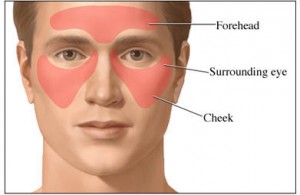
You’re aiming for six points on the face: Large Intestine 20, Stomach 2 and Bladder 2. All three points are pressed twice, symmetrically on both sides of the face, equaling six points. (The seventh is explained below.)

The picture on the right shows how it should look when you’re pressing all six face points. You’re going for just outside the nostril, just below the eye (you’ll feel a little indentation in the bone there—that’s the point), and the inner end of the eyebrow.

In addition to point location, you also want to pay attention to the direction you’re pressing. This is where concentration and coordination come in.

Large Intestine 20, the points outside the nostrils, should be pressed diagonally upward, as if you’re aiming for your eye on the opposite side. Stomach 2, the points below the eye, should be pressed downward toward the mouth. Bladder 2, the ones on the eyebrow, should be pressed upward toward the top of the head.

Maintaining the right point locations and directions may feel awkward at first but it gets easier with practice. For myself and most people I’ve recommended this technique to, the pinkie, ring and middle finger combo seems to work best. But everyone’s fingers and hand coordination are different, so play around with it and do whatever feels most comfortable for you.

Lucky Number Seven: Spleen 5

The six points on the face are considered a local acupuncture approach. In other words, needles (or fingers) are placed at the site of the problem—in this case, near the nasal passages and frontalis muscle on the forehead since this is often where allergy symptoms occur.

But as is true of all conditions, allergies from an acupuncture perspective derive from an underlying imbalance. In addition to the six points on the face, acupuncturists often incorporate a seventh point to address the root cause of seasonal allergy symptoms.

This point is Spleen 5, located below and distal to (toward the toes) the medial malleolus (the prominent bone on the inner ankle). It is done only on the left side.

So why Spleen 5? Many reasons, depending on who you ask, but the primary logic behind using Spleen 5 to treat allergies has to do with its role in resolving what acupuncturists refer to as Dampness.

We could spend a whole article—book actually!—talking just about Dampness. But for the purposes of this article, suffice it to say that Dampness in the body creates fixed, heavy obstructions. Also, when Dampness accumulates, it can turn into Phlegm, which is not exactly but close enough to the phlegm we’re all familiar with and afraid of during allergy season.

Holding Spleen 5 at the same time as the six face points is kind of ambitious. You don’t have to do them all together. Spleen 5 is easy to press while watching TV, reading or doing anything seated that doesn’t require use of both hands.

For me, sitting cross-legged is best. It comfortably exposes the inner left ankle and allows me to access the point with my right index finger. From a desk chair, you can prop your left foot onto your right thigh, which also allows for easy access. Again, it’s important to find the position that is comfortable for you.

It’s unfair that so many seasonal-allergy sufferers view spring as time to stay indoors. No more, thanks to acupuncture. It’s merely time to put on a new face.

Point image from A Manual of Acupuncture

Posted in Uncategorized | Tagged , , , , , , , | Comments Off on Seattle Community Acupuncture: 7 Acupuncture Points for Allergies

Seattle Community Acupuncture: Lose Weight with Acupuncture

Dr. Oz is a fan of acupuncture. Today his website posted the following article about how acupuncture can help you lose weight.  I am reposting the article below because I am commonly asked if I can help someone lose weight via treatments at my community acupuncture studio. The answer is yes, and here are details about how it works!

Using The Healing Power of Qi For Weight Loss

Chinese acupuncture is finally getting under the skin of dieters by tapping into the body’s many hidden energy meridians. The ancient practice of acupuncture helps to heal a host of ailments, and practitioners of Western medicine now embrace it to quell chronic pain, postoperative pain, nausea and vomiting, high blood pressure, addictions and weight loss. When fine needles are barely inserted into the skin along strategic points on the body it can restore balance to the flow of energy along rivers of Qi (pronounced chee), or life force.

There are many reasons people become overweight – hormone imbalances, slowed metabolism, overeating, poor nutrition and lack of exercise are some of the most common.

Using acupuncture to tackle weight loss is a multi-pronged approach.

Pinning Down the Benefits

The rationale for using acupuncture for weight control is based in the premise that weight gain could be the result of disturbed energy flow to and from the regulating center of the brain, called the hypothalamus. The hypothalamus is responsible for maintaining “homeostasis” or functional balance that allows the body to run like a finely tuned instrument. It is the body’s dispatch center that regulates hormones and neurochemicals, and helps to control body temperature, circadian rhythm, thirst and hunger.

Of particular interest is the ability of acupuncture to influence obesity hormones. Research measuring the effectiveness of acupuncture for weight loss found treatments increased ghrelin, a hormone that controls meal initiation and decreased leptin, the hormone that regulates fat storage and metabolism.

The guiding principal is that acupuncture can power up any other weight control strategy by curbing appetite, quelling cravings, boosting metabolism, improving digestion, regulating obesity-related hormones and enhancing the way nutrients are used. It also strengthens the function of the liver, the organ that produces many chemicals critical for digestion, processing nutrients and breaking down of fats. Acupuncture may also increase tone in the smooth muscle of the stomach to help people know that they are full.

Earmark of Acupuncture

To pinpoint the Qi for effective weight control, acupuncturists take aim at 4 acupuncture points on the ear – the hunger point, Shen Men point, stomach point, and endocrine point. A few tiny sterilized needles are inserted along these invisible channels to decrease the “heat” generated along these meridians and to stimulate centers that trigger the release of neurochemicals and hormones.

During some courses of treatment, the needles are covered with tape so that they can be left in place for a few days. Patients later remove them at home or during follow-up visits to the acupuncturist. Some practitioners may also use “ear seeds” that patient wear home that can be massaged periodically to help with difficult-to-control urges.

Guidance For Using Acupuncture For Weight Loss

  • Choose a qualified practitioner – Most states require that acupuncturists be licensed to assure that they have completed the necessary education and training standards to practice. You may see L.Ac. (licensed acupuncturist) following his or her name. Acupuncturists may also be medical doctors or other medical professional who have completed a postgraduate program of study.
  • Complete a full course of treatment – Acupuncture for weight loss is best achieved with 10 treatments delivered over a few weeks.
    Follow a comprehensive weight-loss plan – Acupuncture should be used alongside a comprehensive weight-loss plan, like the Dr. Oz Diet that includes healthy food choices coupled with exercise.
  • Don’t Confuse Treatments — Although ear stapling is loosely based on the concept of acupuncture, it is an imprecise method that uses surgical staples that penetrate the cartilage of the ear, which is know to promote infection
Posted in Uncategorized | Comments Off on Seattle Community Acupuncture: Lose Weight with Acupuncture

Seattle Community Acupuncture: Meet Christina

  Christina M. Williams, LAc, CCHM, LMP

  We’re pleased to welcome Christina, the newest addition to our staff. She is here Thursday

  mornings for acupuncture and massage. Eventually, she will expand her hours. Christina made the  

  great new signage at our studio. Please read more about her: Meet Christina

Posted in Uncategorized | Comments Off on Seattle Community Acupuncture: Meet Christina
206-590-1556 Directions Contact/Schedule